Saturday, June 28, 2014

a Bit About Belief

Some Thoughts of the Pre-Second Coming
Mark 13, Matthew 24 and More


"Four matters are indisputable to Latter-day Saints: (1) The Savior will return to the earth in power and great glory to reign personally during a millennium of righteousness and peace. (2) At the time of His coming there will be a destruction of the wicked and a resurrection of the righteous. (3) No one knows the time of His coming, but (4) the faithful are taught to study the signs of it and to be prepared for it. I wish to speak about the fourth of these great realities: the signs of the Second Coming and what we should do to prepare for it."
(Dallin H. Oaks, April 2004 General Conference, Preparation for the Second Coming)

Today I want to discuss Elder Oak's third point: the signs of the Second Coming. These are given many times throughout the scriptures. In that same talk, Elder Oaks describes these signs in a list form:

"Biblical and modern prophecies give many signs of the Second Coming. These include:

1. The fulness of the gospel restored and preached in all the world for a witness to all nations.
2. False Christs and false prophets, deceiving many.
3. Wars and rumors of wars, with nation rising against nation.
4. Earthquakes in divers places.
5. Famine and pestilence.
6. An overflowing scourge, a desolating sickness covering the land.
7. Iniquity abounding.
8. The whole earth in commotion.

9. Men’s hearts failing them."

The time before the Second Coming, as described in Mark 13, seems to be a time of testing for the righteous believers of Christ. They will have the opportunity to display their loyalty to and faith in Jesus Christ. The faithful will look for the signs of the Savior's return, and will be ready for His arrival. Verse 32 reads:

"But of that day and that hour knoweth no man, no, not the angels which are in heaven, neither the Son, but the Father."

No one except Heavenly Father knows the day or time: this is repeated all throughout the scriptures. There are a lot of people who claim to know the day of the Second Coming, or of other significant events involving a rapture from their earthly plights. Our job is not to try to speculate the Lord's time, but to prepare ourselves for when the Father says we are ready. 

Verse 22 reads:

"For false Christs and false prophets shall rise, and shall shew signs and wonders, to seduce, if it were possible, even the elect."

The closer that we get to the Savior's return, the more divine fallacies will arise. The elect mentioned in the scriptures are people who have made sacred gospel covenants- people who consider themselves strong and faithful. There will be false Christs and false prophets. Who are the false prophets? Read this quote from Elder M. Russell Ballard's October 1999 General Conference talk: 

"When we think of false prophets and false teachers, we tend to think of those who espouse an obviously false doctrine or presume to have authority to teach the true gospel of Christ according to their own interpretation. We often assume that such individuals are associated with small radical groups on the fringes of society. However, I reiterate: there are false prophets and false teachers who have or at least claim to have membership in the Church. There are those who, without authority, claim Church endorsement to their products and practices. Beware of such."
(M. Russell Ballard, October 1999 General Conference, Beware of False Prophets and False Teachers)

Who are they? They are regular people, who are seemingly righteous. They pretend to do good in the name of the people, but go against the Lord's wishes. False prophets lead away many hearts that are not strong enough to see them for the spiritual virus that they are. They will suck the Lord's light out of their followers- sometimes even in the name of God, or some other value of a bleeding heart. False prophets convince good members of the gospel to follow in their ways, and together, they slowly leave the protective arms of the Spirit and eventually leave the gospel. False prophets come in the form of women seeking the priesthood, in the form of leaders of marriage equality, or even in more subtle and hidden ways. They are a careful poison, given in small enough doses to keep an unsuspecting sympathizer unaware of their spiritual malignancy. 

False prophets, false Christs, persecution of believers...these signs of the Second Coming are like a spiritual survival-of-the-fittest. Those who desire and work to be strong, will survive and be happy. Those who get complacent, who get spiritually distracted, or choose to be offended....they will fall away and find, that somewhere along the line, they lost their Salvation.

So what, then, are we to do? Here is another quote, this one from Elder Richard G. Scott:

"A strong testimony has sustained prophets throughout the ages and fortified them to act with courage and determination in times of difficulty. A powerful testimony can do the same for you. As you fortify your own personal testimony, you will have power to make correct choices so that you can stand unwaveringly against the pressures of an increasingly vicious world. Your personal security and happiness depend upon the strength of your testimony, for it will guide your actions in times of trial or uncertainty."
(Richard G. Scott, October 2001 General Conference, The Power of a Strong Testimony)

To make it through the Satan's eventual storm of trickery, Christ's followers will need to figure out what they believe and in whom their faith lies. They will need to look for Christ's coming, full of faith and loyalty. Believers will need to be able to distinguish God's own will from the will of self-serving do-gooders who profess the ability to improve and fix Heavenly Father's unbroken church. 


I know that these are the days leading up to Christ's return. I know that the Savior will come back to this Earth once more, in his fullness of wonder and amazement. I know that there will many opportunities for growth- all with the potential for both greatness and doom. As I live faithfully, and strive to remain strong in my testimony, I will pass through this life of fallacy and wickedness, and come out refined and polished. Someday, I don't know when, I will get to feel Christ's physical scars of His spiritual sacrifice for me. I will get to hear His voice, and listen to Him tell me that I made it. I know it's real, every part of my heart tells me it's true. Someday Christ will walk this earth again, I know it. 

Saturday, June 21, 2014

a Seven Day Rundown

a Seven Day Rundown
As explained in the institute manual: The Life And Teachings of Jesus & His Apostles, pp. 135-137.


My institute manual gives a rundown of the last week before Christ's death, and also His resurrection. Really understanding how He spent his last few days before the crucifixion has given me a new level of respect and a deeper love of the Savior. His complete faith in the Plan, and His lack of any fear for the future is amazing. He knew he would suffer, he knew he would hurt and he completely understood that he would be killed. The details didn't matter, because he had a mission to fulfill; one that would save me, and my children, and make us stand a chance in eternity. 

Day 1 (5 days before the crucifixion): Jesus Christ rode a donkey in to Jerusalem and people gathered around Him while he rode up to the temple. He noted the things taking place at the temple and then He left the city and returned to Bethany for the evening. 

Day 2 (now 4 days to go): Jesus rode again up into the temple. There, he challenged the Jewish leadership, by throwing out of the temple all of the wicked money exchanging going on within the sacred building. The Jewish leadership had previously allowed business and sales to go on in the temple, so when Jesus evicted the those acting in a less-than-sacred manner, those leaders got angry. Christ reminded people that the temple is a place of worship, not a marketplace. Christ left the temple and again spent the night in Bethany.

Day 3 (3 days to go): The next morning, when Christ returned to the temple, he was interrogated by the Jewish leadership. They tried to trick Him, and make him contradict himself. Christ answered the wicked leaders with parables. Unhappy and offended by that, they tried to trick him again. Christ then called them out on being hypocrites and let them know that they were wrong. Christ left them, and did not preach anymore to crowds- only to His apostles. Angry with Christ, the Jewish leaders tried to think of ways to make sure that He was put to death. They worked on concocting a plan that would let them arrest the Savior without causing a scene that might spark an rebellion or riot. 

Day 4 (2 days left): Christ was aware that his mortal life was coming to an end. There aren't really records of what He did on this day, as it was written down in the scriptures. However, it was spent outside of Jerusalem.

Day 5 (the day before): Christ and His apostles spent the Passover alone. He introduced the Sacrament ordinance to them that night. Jesus also explained to the apostles that he knew His end was coming, and told them of Judas's upcoming betrayal. After His intercessory prayer (or a prayer on behalf of
other people), 11 of the 12 apostles (Judas was busy betraying) left and went to Gethsemane. Just inside the garden, Christ left all the apostles but Peter, James and John, who went with Him deeper in to the garden. After a while, the three apostles stayed behind as Christ went on alone to pray. 

In this garden, at this most holy of times, the Savior knelt in prayer and atoned for the sins of every person who has, or will ever walk the Earth. The pain and sorrow that I feel for just my own selfish self is sometimes unbearable. Christ felt that. He also felt that for every single other person ever. He suffered and felt excruciating pain, so that I would not have to. All of His anguish was felt and endured in behalf of other people. I will forever feel grateful, and blessed, but so unworthy of His perfect love for me. 

Continuing with Day 5...after he had selflessly atoned for each of us, he returned to Peter, James and John, and they all returned back to the other apostles who awaited them. Christ announced that Judas and the Jewish leaders would be there soon, and they did. Christ did not struggle or fight back as they placed Him under arrest and marched Him in to an illegal trial in the middle of the night. 

Day 6 (the day of the crucifixion): Those Jewish leaders worked really hard at scraping up any possible charges they could to make sure that Jesus was put to death. He was given two charges: blasphemy (with which He was unanimously convicted) and sedition (of which he was found not-guilty by Pilate, a Roman governor. However, just outside of Pilot's judging room, the wicked leaders were egging the crowd to demanding a death sentence for Christ. Pilate was scared of a rebellion, so he agreed to it, knowing of His innocence. 

So on day six, Jesus Christ, Savior of the world, was crucified in the brutal roman fashion of the cross. Eventually, that afternoon, he gave up his body and sent His spirit home to His Father. Because of the next day being the Passover holiday, and also the Sabbath, Christ was taken down from the cross that night and placed in a sealed tomb by two of His loving disciples.

Day 7 (one day after Christ's mortal death): While His body remained in the tomb, Christ's spirit went to the spirit world to minister unto all those spirits there. In doing this, as we learned last week, Christ forged a gate between Spirit Paradise and Spirit Prison, allowing all those spirits in prison to have to opportunity for conversion.

Day of the Resurrection: Christ left his tomb where His body had been laid, and there met Mary. There are several witnesses to Christ's body arisen from His death. Many saw the scars from his body being crucified. I wasn't aware of this, but apparently this part of the scripture accounts are called "the good news." Christ died, and was resurrected, setting a perfect precedence for us: we will die, and will come alive again, and be resurrected some day.

The last 5 days that preceded Christ's mortal death were amazing. His atonement, crucifixion and resurrection are all because of His love for each of us, and for our Heavenly Father. I am truly blessed to have been able to do this assignment this week, and my heart is full knowing what I know. I encourage everyone to study all of the elements of His last mortal days and the days following.

Saturday, June 14, 2014

a Parable or Two

a Parable or Two
Luke 16-18


It is pretty widely known that the Savior chose to speak to his disciples in the form of a parable- or a story with a lesson hidden somewhere in the middle of it. Some of them are pretty well known and understood, like the parable of the Ten Virgins. However, there are many, many more that are less popular and less widely comprehended. Taking the time to study the principles found within parables is seeking to hear what Christ wants us to know. Below are some of the parables found in Luke 16-18. 


The Parable of the Unjust Steward (Luke 16:1-12):
Basically, there was a steward (I imagine this to be the bookkeeper or financial guru for a household), who worked for a very rich man. The rich man caught wind of the steward wasting his resources, and called him in to discuss it. He put the steward on probation. The steward, feeling nervous and threatened, thought up a plan to get back into good graces with his master. He called up all of the people that owed things to the rich man, and struck deals with the debtors. He collected only portions of what they owed to the rich man, which worked out pretty well for the debtors. This debtors were happy with the steward, and he made some friends. The master was pleased with the steward, because he saw that he was looking down the road. 

This is a very confusing parable at first. Does that mean that the Lord condones dishonesty? In his book, Jesus is the Christ, James E. Talmage clarifies this for us: 

"On first reading, the parable of the Unjust Steward would seem to be an endorsement for malfeasance in office. Careful study will show, however, that it was given to teach the care with which the saints of God should approach the task of preparing for their eternal future. Knowing that he had but a short time left in his appointed post, the steward wisely tried to secure his future by winning some friends.

"It was not the steward’s dishonesty that was extolled; his prudence and foresight were commended, however; for while he misapplied his master’s substance, he gave relief to the debtors; and in so doing he did not exceed his legal powers, for he was still steward though he was morally guilty of malfeasance. The lesson may be summed up in this wise: Make such use of your wealth as shall insure you friends hereafter. Be diligent; for the day in which you can use your earthly riches will soon pass. Take a lesson from even the dishonest and the evil; if they are so prudent as to provide for the only future they think of, how much more should you, who believe in an eternal future, provide therefor!" (pg. 464)


The Parable of the Rich Man and Lazarus (Luke 16:19-31):
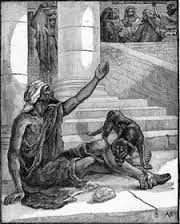
In this parable, there is a very rich man and a very poor and sick man named Lazarus. The rich man thinks very highly of himself, and refuses to provide any help or support to Lazarus, even while the dogs licked up his wounds. Eventually the beggar, Lazarus, died and was carried away to Abrahams bosom (Spirit Paradise). He experienced a loss of his fears, troubles and sorrows. In it's place grew peace, joy and rest. 

Soon after, the rich man also died and was sent to hell (Spirit Prison). His experience was much different, as he dealt with weeping, wailing, gnashing of teeth, darkness and constant fear. Because of the awful state he dwelt in, he asked for help getting out. He was reminded frankly that he chose not to help the beggar Lazarus when they were both alive. He was also explained that there was a huge "gulf" between the Spirit Paradise and the Spirit Prison, that divided the two places and kept the spirits from connecting with the other side. 

He then asked to visit his family that he left behind to preach to them of his newly acquired understanding of the plan. He was told that they would be sent prophets (missionaries, scriptures?) to teach them. He was also told that it wouldn't matter if he went back to teach them from the grave, if they didn't accept the prophets, they wouldn't accept the truth. 

After Christ's spirit left his body, he spent three days teaching and preaching in the spirit world. When he went there, he created a bridge over the "gulf" between the Spirit Paradise and the Spirit Prison. About this, Bruce R. McConkie says: 

"The Savior’s visit to the spirit world bridged the gulf between paradise (Abraham’s bosom) and hell, making it possible for the spirits in prison to receive the message of the gospel by authorized ministers."


The Parable of the Ten Lepers (Luke 17:11-19):
This parable begins with some men who suffered from leprosy. Leprosy is a nasty disease, where chunks of skin falls off of the infected person, exposing their insides to plain view. It was very contagious, and caused lepers (people with leprosy) to be cast out from the cities. In order to be able to come back to their homes, families and friends, they had to be pronounced clean by a priest. Rarely did this happen, and once diagnosed with leprosy- you pretty much expected to die alone in the hills.

As Christ was walking one day, he was surrounded by ten lepers, who sought Him to be healed. In verse 13 they said "...Jesus, Master, have mercy on us." Christ then told the lepers to go show themselves to the priest. Bruce R. McConkie says about this that,

 "Jesus also told the lepers to show themselves to the priests as a test of their faith.When all ten believed and complied with the terms of the cure, all were healed “as they went” to visit the priests. "

After they were healed, only one former leper out of all of the 10 former lepers came back and found Christ to thank him. Verse 17 reads: "And Jesus answering said Were there not ten cleansed? but Where are the nine?" And of all of them, he was a Samaritan who would have typically been looked down upon! Elder Bruce R. McConkie said about this: 

The one who returned to give thanks was a Samaritan, and “perhaps this exhibition of gratitude by a Samaritan was another evidence to the apostles that all men are acceptable to the Lord and that the Jewish claim to exclusive superiority as a chosen race was soon to be replaced with a command to take the gospel of peace to all races.”

I wonder how many times we forgot to stop and say thank you? Are we like the Samaritan, or are we like the other nine? 

The Parable of the Unjust Judge (Luke 18:1-8)
In this parable, Christ tells about a poor widow who sought the help of a judge, seeking to get rid of some of her adversaries. The judge, who was very selfish and wicked, decided not to help the widow. Then, after a while of her asking, it seems like he just got tired of it and helped her. He didn't help her because it was the right thing to do, or because he wanted to be nice--he helped her because it was beneficial to him.

This parable is kind of a tricky one, and a lot of people get caught up thinking that Christ is comparing himself and Heavenly Father to this wicked judge. That is not the case, though! Verse 4-5 tells about the heart of the judge, who said

 "Thought I fear not God, nor regard man; Yet because this widow troubeleth me, I will avenge her, lest by her continual coming she weary me."

Jesus Christ uses this parable to teach us that even that wicked judge finally helped the poor widow eventually, even if it was for the wrong reasons. If the judge, being so full of himself, would help someone in need, of course God will too! We should not get caught up in doubt, wondering if God hears our prayers, or if he will answer any of them. Of course He does! There may be a lesson we are gaining, so we need to remember that our desired timing often times does not coincide with the Heavenly Father's timing. So be patient, and hang on tight to your faith!


The Parable of the Pharisee and the Publican (Luke 18:9-14):
The final parable for this post concerns a Pharisee and a Publican (tax collector). Both men went up to the temple at the same time to pray. In the Pharisee's prayer, he told God about how awesome and righteous he was, and made a running list of all of the good things that he did all the time. He also took the opportunity to tell God how much better he was than all of the other people. By contrast, the Publican quietly prayed, and asked God for mercy, and explained that he lacked. 

Christ then explains that the Pharisee is no better than the Publican, even though he wanted to believe he was. In verse 14, about the publican he says: 

"I tell you, this man went down to his house justified rather than the other: for every one that exalteth himself shall be abased; and he that humbleth himself shall be exalted."

In Jesus the Christ, James E. Talmage says: 

"We are expressly told that this parable was given for the benefit of certain ones who trusted in their self-righteousness as an assurance of justification before God. It was not addressed to the Pharisees nor to the publicans specifically. The two characters are types of widely separated classes. There may have been much of the Pharisaic spirit of self-complacency among the disciples and some of it even among the Twelve. … The parable is applicable to all men; its moral was summed up in a repetition of our Lord’s words spoken in the house of the chief Pharisee. …"


Studying parables give us a unique opportunity. We learn the important principles of the gospel, in exactly the way the Christ wants us to hear them. This was a difficult assignment for me, mostly because I am not very smart. But after days of studying, I think that I was able to really grasp a better understanding of what I need to be working on! I encourage everyone to look up these parables and really seek to understand them. They are powerful and will bless you as you try to hear the message!


Saturday, May 31, 2014

a Pinch of Rocky

Rocky and My Shepherd
"Jesus Christ is My Shepherd"


Have you ever seen a baby sheep? Our friends, J & A, have a farm and just bought a flock of sheep. A whole flock! They found a good deal on Craigslist, and purchased 16 sheep. There were mommy sheep, one daddy sheep, and tons of little baby lambs. They are the cutest little fuzz balls that I have ever seen!

About a week after they got the sheep, one of the younger teenage sheep, who they didn’t even know was pregnant, had a little baby sheep in the middle of the night. While in lamb-birth, the mama found herself surrounded by some coyotes outside of her barn. As you would expect, she was a little distressed and when early morning came, J & A heard some soft whining. To their surprise, they found a baby lamb. The mama sheep still wants nothing to do with it, she actually tries to kill it! They think she might associate the lamb with the coyotes. It is very sad.

But now, J & A have their own little lamb! It is adorable and so tiny, and I fall in love every time that I see it. That being said, I am REALLY glad that J & A have a lamb and that we deal strictly with humans. J & A take turns bottle feeding the lamb every four hours, even during the night time. It has become so attached to them, that he cries every time J & A are around but busy doing something else. The lamb, Rocky, is such a huge handful, that they have tossed around the idea of selling him (or eating him), a few times. They are too attached now, so they never would hurt that baby. In fact, they are very protective of Rocky, and very sensitive to how he is adapting to his farm life.

I thought of Rocky a lot this week while doing the reading for my religion class. We are learning about Jesus Christ as our shepherd. Because of my recent experience in lamb-li-ness, I am able to gain a little prospective on the topic. I don’t think I could handle the care of one little Rocky, much less millions and millions of little Rockys!

In John 10, Christ is compared to a shepherd. I learned from my manual that shepherds back in those days were very faithful and loyal to their sheep. They would even give their own life in protection of their sheep. They kept their sheep in a sheepfold at night, which is big, tall walls, that have sharp points sticking out of the top to keep predators out. There was only one way in, the door. At nighttime, one shepherd would watch several different flocks of sheep in the sheepfold, and he would stand guard at the door while all the other shepherds slept in their homes.

Vocab: That shepherd standing guard was called a porter.

When the sun came up, the shepherds would return to the sheepfold to collect their sheep. The porter personally recognized each shepherd, so he would allow only shepherds to go in to get sheep out. Here is where it gets interesting.

Verse 10 reads: “To him the porter openeth; and the sheep hear his voice: and he calleth his own sheep by name, and leadeth them out.”

When the shepherds would go in to the sheepfold, each shepherd would call his flock and lead them to where they were headed that day. The sheep were so attached to the shepherd, that they actually recognized their master by his voice! Up until the last few weeks, I would have been shocked that that could happen. But because of my experience with Rocky, I totally believe that! I have seen Rocky search out only the A in J & A, and whine to be fed. I believe that each one of those sheep in the sheepfold can tell when their master is the one calling.

In verse 5 states: “ And a stranger will they not follow, but will flee from him: for they know not the voice of strangers.”

There are several things that our lesson for this assignment touched on, but this was the part that touched my heart the most this week. Which leads me in to a few questions:

How is Jesus Christ like those shepherds?

First, he would do anything for the sheep. We know that because he already did. The porter would do anything for the sheep, even give up his own life. Christ, who loved each of us so much gave his own life as a humble sacrifice to save us.

Second, Jesus Christ knows each of us individually. The shepherd knows his sheep, he can even call them each by name. What a marvelous blessing it is to know that the Savior knows me, personally, and loves me as an individual!

Third, His sheep know His voice. When a shepherd calls his sheep, they come. When someone else calls them, they are scared and confused. 

How do we know if we are one's of the Savior's fold?

A good way to tell if you are part of the Savior's fold, is to ask yourself, "can I recognize the Savior's voice?" Can I listen to the words of the of the Savior, and know that it is Him? Part of being able to recognize His voice means that I have to be able to hear it. Are there distractions all around me that prevent me from hearing my shepherd? Can I hear words of divinity and recognize them as truth?

I can't imagine the love that the Savior must feel for each of us, to be able to give His own life in behalf of this crazy flock. I am so grateful that he knows me by name, and that he wants me to be a part of His flock so bad, that he suffered the Atonement in my behalf. I feel honored to be a part of His flock!

Saturday, May 24, 2014

Which Group Am I In?

a Tittle of the Followers
John 6


It all started right after the multitudes of people gathered on the hillside (see above pic), and the people witnessed the complete miracle that Jesus Christ performed with the bread loves and the fish. While they were understandably in awe of what was happening, many people neglected to hear the Savior's words and teachings and focus only on the physical act of the miracle. They were so excited to see a good show, that they missed all of the important parts!

The people then followed (almost stalked), Christ, until they finally caught up to him. They asked him
"....Rabbi, when calmest thou hither?" (John 6:25)
To which he replied: 

"..Verily, verily, I say unto you, Ye seek me, not because ye saw the miracles, but because ye did eat of the loaves, and were filled." (John 6:26) 
or  
JST: "...ye desire to keep my sayings, neither because ye saw the miracles."

He knew that those people were not there to hear his words, or find more truth in his teachings. They were there to see what they might compare to a circus act. When something spiritually magnificent like this takes place, the "blind" people don't see the reason behind it, and can only see the coolness factor. 

Which should lead us to question our own motives: 

What motivates my desire to "seek" the Lord?

Do I have the right reasons for seeking the Lord, or do I have more superficial motives? As I thought about what might constitute a superficial motive, I realized that they were sometimes very sneaky. Sometimes a motive that might be a righteous and praiseworthy choice, might not be the best reason. For example: I made a list, and on this list, I put all of the reasons that I personally feel a motivation to follow Christ. It looks like this:
-A deeper testimony
-A better understanding
- Stronger faith
These are all good choices- they are things that will bring me closer to Christ, and they will better my life. The bottom of my list looked like this:
-For my children
-For my husband
-Because I should
While these are good things, and very respectable (at least I thought so), they may not be sufficient for motivation. Shouldn't my desire to "seek" Christ be because I need it, and can't imagine living my life without it? After a lot of reflection this week on my list, I decided to take the bottom half of the list off.  Why? Because I think that those are less like motives, and more like consequences. As I strive to attain the first half, the second half happens as a result. I need to seek Christ, for myself  and with the right motives. In turn, my husband and my family will be enriched. Step one: Check your motives.

Christ, knowing the unholy motives of the people, gave them the opportunity to understand, by presenting them with the Bread of Life discourse. He tells them, in verse 27 of John 6:

"Labour not for the near which perisheth, but for that meat which endureth unto everlasting life, which the Son of man shall give unto you: for him hath God the Father sealed."

To the reader, this means to look and work for the things that do not end in this life, but for things that we carry with us into eternity. Another example of this is found in Matthew 6:19-20, where Christ talks about treasures on Earth, and treasures in heaven. 

"Lay not up for yourselves treasures upon earth, where moth and rust doth corrupt, and where thieves break through and steal:
But lay up for yourselves treasures in heaven, where neither moth nor rust doth corrupt, and where thieves do not break through nor steal:"

Simply written, things on this earth perish, but things of heaven last forever. What are things of Heaven then? Your faith, your testimony, your education, your understanding and your choices. 

Then, in verse 21 of the same chapter, Christ tells the people:

"For where your treasure is, there will be your heart also"

Christ tells them that whatever they hold as treasure, will also be their priority. So now, I ask myself this question: 
What do I consider to be treasure? 

Do I cling to my scriptures and honestly seek Christ in prayer, holding every ounce of faith and testimony as my greatest possession? Or do I just really like my boat/car/kids/husband/toys/
computer/house/job..... the most? Because what ever the answer to that question is, determines where my priorities lie. Step Two: Pick priorities.

In John 6:35, Christ explains to the people where their priorities should be, and where to find the treasure. 

"I am the bread of life: he that cometh to me shall never hunger; and he that believeth on me shall never thirst"

If we want to fill ourselves with eternal life, then we need to partake of the Bread of Life, which is Jesus Christ. We need to seek Him, we need to partake of His sacrament, and we need to follow His ways. 

The people, because of their levels of faith, were divided into three groups:

Group 1 
People who didn't want to understand and mocked Him (John 6:41)
Group 2
People who left Him when they thought it was hard (Disciples in John 6: 66)
Group 3
People who were willing to understand and follow Him wherever he went (Apostles in John 6:68-69)

This brings me to the third, and final question I have today: 

Which group am I in?

A few weeks ago, my brother, Justin, asked my daughter, Jadyn (6),  to participate in a High School pageant as his escort for the night. She practiced and worked really hard with the older teenage girls to learn the dances and parts that they would all be performing for the event. As the time of the event grew close, Jadyn was informed that it was a formal event, and that she would need to be in a real formal dress. The older High School aged girls showed her their dresses in a dress rehearsal, which were very beautiful, but very immodest. Jadyn, being young, was in love with the dresses!!

We went to the mall that night and looked in dozens of stores for a dress. Jadyn didn't like any of them. Finally we asked her what she was looking for, and she said she wanted a sleeveless one (and it had to be Elsa blue). We explained to her the standard of our church, and the commandments from the Lord to dress modestly. I think initially she was upset, but she quickly decided to follow the commandments. She was the only girl up there with sleeves on her dress, and she looked amazing. She even proceeded to tell the other older girls about the commandments. I was so proud of her! Jadyn was small, but I will always remember her great faith and desire to do whatever it takes. Jadyn is in Group 3.

Sometimes when we are faced with difficult decisions, it would be really easy to turn and walk away. But before we do this, first, consider this scripture in John 6, where Christ turns to His apostles after witnessing Groups 1 & 2 leave him: 

"Then said Jesus unto the twelve, Will ye also go away?" (John 6:67)

It is important for us, as disciples of Christ, to know where we stand. What group are we in?  When things are difficult, will I leave Him? If I don't understand the teachings, will I choose to complain or disagree? Or will I, no matter what he asks of me, choose to follow Him wherever he takes me? 

(I want to be in Group 3. )

Saturday, May 17, 2014

A Jot about John

John the Baptist
Matthew 11:1-19, Luke 7:18-35


In Matthew 11:2-3, John the Baptist sends his apostles to go to Jesus Christ. He tells them to ask Him the following question:

"Art thou he that should come, or do we look for another?"

Or maybe in other words: John asked us to see if you really are the Christ, or should we just keep looking? This is very confusing to a lot of folks. They wonder: 'did John really second guess the Savior?' However, the question is not as important, as is the reason behind it.

At that time, the apostles clung on very hard to John as a prophet. They were obedient and faithful, but had a hard time letting go of him and attaching to Christ. By John sending them out to Christ to ask this question, it actually gave those men the ability to see for themselves. John the Baptist knew that if they were able to see Him, and witness is divinity, that they would gain a knowledge sufficient to reroute their loyalty. And it did exactly that: Christ performed miracles, taught and gave blessings. He spoke directly to them, with all the wisdom, humility and patience you would expect. Then they left to go find John.

If I had been in their shoes, I would have run straight over to John, and would probably have been freaking out. I can't imagine how they felt, or how they contained themselves! I would first describe to John the feeling that filled my heart when Christ spoke right to me, as he testified of His divine role.  Then I would try to describe the directness, love and the meaning that is hidden within His words. And lastly, I would tell John all about the miracles that I had witnessed: people healed, taught and administered to. I can't imagine how those two apostles felt after being there to witness all of that!

Later on in Matthew 11, after those two apostles left, Christ proceeded to tell the multitudes of people about John. In verse 11, he told them that "Among them that are born of women thee hath not risen a greater than John the Baptist...." Joseph Smith explained this with three reasons:

“First. He was entrusted with a divine mission of preparing the way before the face of the Lord. Whoever had such a trust committed to him before or since? No man.

“Secondly. He was entrusted with the important mission, and it was required at his hands, to baptize the Son of Man. Whoever had the honor of doing that? Whoever had so great a privilege and glory? Whoever led the Son of God into the waters of baptism, and had the privilege of beholding the Holy Ghost descend in the form of a dove, or rather in the sign of the dove, in witness of that administration? The sign of the dove was instituted before the creation of the world, a witness for the Holy Ghost, and the devil cannot come in the sign of a dove. The Holy Ghost is a personage, and is in the form of a personage. It does not confine itself to the form of the dove, but in sign of the dove. The Holy Ghost cannot be transformed into a dove; but the sign of a dove was given to John to signify the truth of the deed, as the dove is an emblem or token of truth and innocence.

“Thirdly. John, at that time, was the only legal administrator in the affairs of the kingdom there was then on the earth, and holding the keys of power. The Jews had to obey his instructions or be damned, by their own law; and Christ Himself fulfilled all righteousness in becoming obedient to the law which He had given to Moses on the mount, and thereby magnified it and made it honorable, instead of destroying it. The son of Zacharias wrested the keys, the kingdom, the power, the glory from the Jews, by the holy anointing and decree of heaven, and these three reasons constitute him the greatest prophet born of a woman."

I talked to my mom, who is a a wealth of knowledge of all things scripture, because I didn't understand what was meant by #3 of Joseph Smith's reasoning. She explained to me that in those days, the Law of Moses was still in affect. The Law of Moses, she said, was initially created by God, but the leaders down the line added their own laws and requirements. Because there was not separation of church and state, John was recognized as someone that they were legally liable to. This, as Joseph Smith and my mom said, was only upheld by the Jews. Now, not only was John the Baptist a legal authority, but he also held the keys to the Aaronic Priesthood for the power of Baptism. Thus, mom explained, John was a legal administer, as well as a spiritual leader. Thank goodness for Moms!

I can see why his apostles were so deeply attached to him! They witnessed him fulfill his callings in life, and saw his great work. They probably loved John for his sacrifices and his faith. And still, John needed to help them to love and respect Jesus as the Christ. 

Finally, in complete humility, John, in verse 30 of chapter 3, says:

"He must increase, and I must decrease"

He knew that his disciples would not stop clinging to him, but he knew that he needed them to follow and have faith in Jesus Christ. And so... he knew that he needed to fall back and let the Savior take the lead.

This is a great example for all of us of perfect humility. Do we let the Savior have the total lead in our lives? Do we allow Him to increase, while we decrease our own will? I think this is a particularly hard thing to do for our generation. It is much easier to trust a Google search, than it is to listen for the quiet whisperings of the Holy Ghost as it so reverently sends us the answers to our questions.

I am grateful for the work of John the Baptist, and for his different callings to prepare the world for the Savior. I am especially grateful for Jesus Christ, and for the feeling that I get in my heart when I read His words. I know that He is my Savior, because I can feel it when I take the time to study.


And thank you mom!